Be clear on what you want
Many students set out to learn Arabic without ever pausing to ask what that means. Arabic is not one skill. It is four. Reading, writing, speaking, and listening each pull on different muscles, and a learner who does not pick a target tends to make slow progress in all four at once.
So before anything else, decide. Do you want to speak with family in Cairo? Read the Quran with understanding? Write essays? Listen to a khutbah and follow it line by line? Each of these asks for a different mix of effort.
For most of our students, the goal is not basic spoken Arabic. It is depth. They want to open the Quran and read it without leaning on a translation. They want to sit in the gardens of tafsir and follow the discussions and reflections on an āyah. They want hadith, sīrah, and the classical sciences to feel like a home rather than a foreign country.
That is a higher bar than learning a few hundred words. It is also reachable, with the right system.
Grammar is the skeleton, not the body
Beginners often think Arabic is grammar. They start with case endings and verb forms and assume that if they master those rules, the language will fall into place.
Grammar matters. Without it, a sentence collapses. But grammar on its own is a skeleton with no body. You cannot move it. You cannot live in it.
There is a saying among the early scholars:
النحو في الكلام كالملح في الطعام
Grammar in speech is like salt in food.
Too little, and the speech is unseasoned and unclear. Too much, and it overwhelms what you came to taste. Salt is essential, but no one sits down to eat salt.
The body of the language is its vocabulary. The words are what carry the meaning. Grammar lets the words stand up; the words are what you actually want. This is the same reasoning behind our method, which builds the grammar quietly underneath the reading rather than in front of it.
Why vocabulary is the hardest part
Vocabulary is where almost every Arabic student gets stuck, and the reason is simple. You do not live in an Arabic-speaking environment. You do not bump into the same word ten times in a week the way a child in Damascus does. You see a word once in a textbook, write it on a flashcard, and three weeks later it has dissolved.
This is not a memory problem. It is an exposure problem.
Research on second-language acquisition has been clear on this for decades. The brain remembers words alongside the context they came in. Where you read it. What was happening in the sentence. What feeling the passage carried. Words learnt in isolation fade. Words learnt inside a story tend to stay.
In fact, reading sits at the core of any successful language learning. Reading gives you words inside the world they belong to.
How Nuqta is built around this
Our curriculum runs on two tracks at once.
The first is a structured study path. Bite-sized lessons that build the skeleton of the language, one step at a time. Done a little each day, they add up faster than most students expect.
The second is daily reading, woven into the same app. We start gently. Arabic words are blended into English passages so that you are never standing in front of a wall of script you cannot read. As your confidence grows, the proportion shifts. More Arabic, less English. Eventually you are reading full Arabic texts on a wide range of topics, and from there into tafsir, hadith, and the deeper Islamic literature.
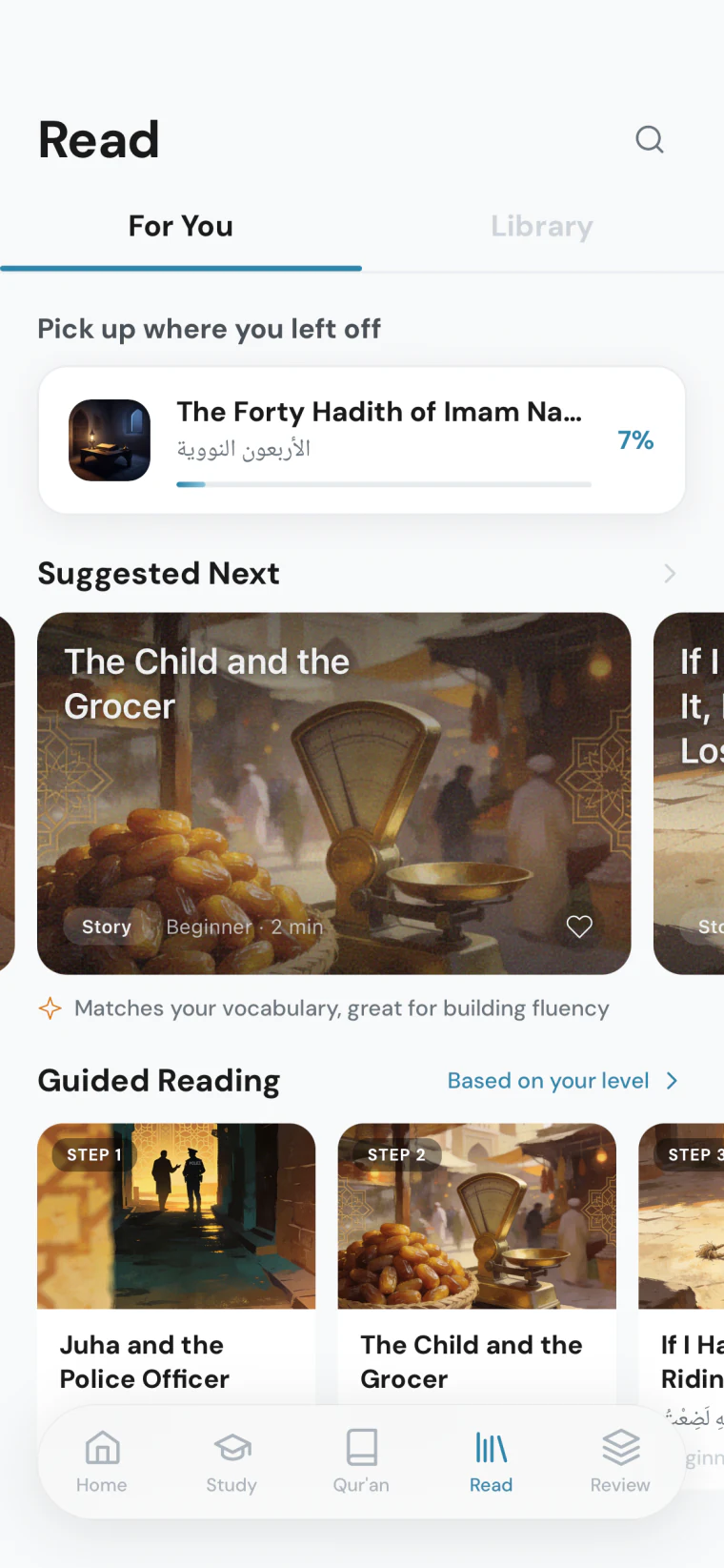
The point of this design is to remove the wall that stops most students. You do not have to wait years before you can read something meaningful. You read from the first week, at your level, and you keep reading.
Reviewing what you have learnt
Even a word seen in a beautiful passage will fade if you never meet it again. Review is not optional. The question is how to do it without burning out.
We use two methods.
The first is a review deck. Words you have not yet locked in get added to a deck, and you see them again on a schedule designed by the algorithm. You only review what you actually need to review, and the deck stays small.
The second is listening. Every passage and book in the app has an audiobook. Once you have read a passage, you can listen to it later, on a walk, in the car, while cooking. Listening to text you have already read is not passive. It is review at full speed. It rebuilds your passive vocabulary, which is the vocabulary you understand when you hear or see it without having to stop and think. If a word slips while you are listening, tap it. The vocab sheet is one tap away.
Why so many students never get there
Many learners study for years through vocab apps or with a private teacher and still cannot open a book and read it without a dictionary every other line.
The reason is rarely effort. The reason is the system.
Most courses teach vocabulary lists, or grammar rules, or both in isolation. They never close the loop. There is no daily reading at the right level. There is no spaced review. There is no listening practice on familiar texts. Each piece works in a corner, and none of them feed each other.
Even students who travel abroad to immerse themselves often come home and watch what they learnt slip away within months. The trip gave them words; what they lost was the daily habit. Without consistency, vocabulary leaks. With it, it compounds.
A language is learnt the way a body grows. Skeleton, flesh, and blood together. Pull any one of them out and the whole thing slows.
The path forward
Be clear on what you want. For most of our students, it is real depth in the Quran and the tradition that grew around it.
Build the skeleton with short, daily lessons. Feed it with reading at your level, every day. Review with the deck and the audiobooks. Do not chase speed. Chase consistency.
Arabic is not a language you sprint through. It is a language you live with. Give it a few months of honest, daily practice and what was once a wall starts to soften into a window.
And remember that real progress in this language, like in anything worthwhile, comes with توفيق from Allah. Show up daily, do your part with sincerity, and ask Him to bless the effort.
Prefer to read it on paper?
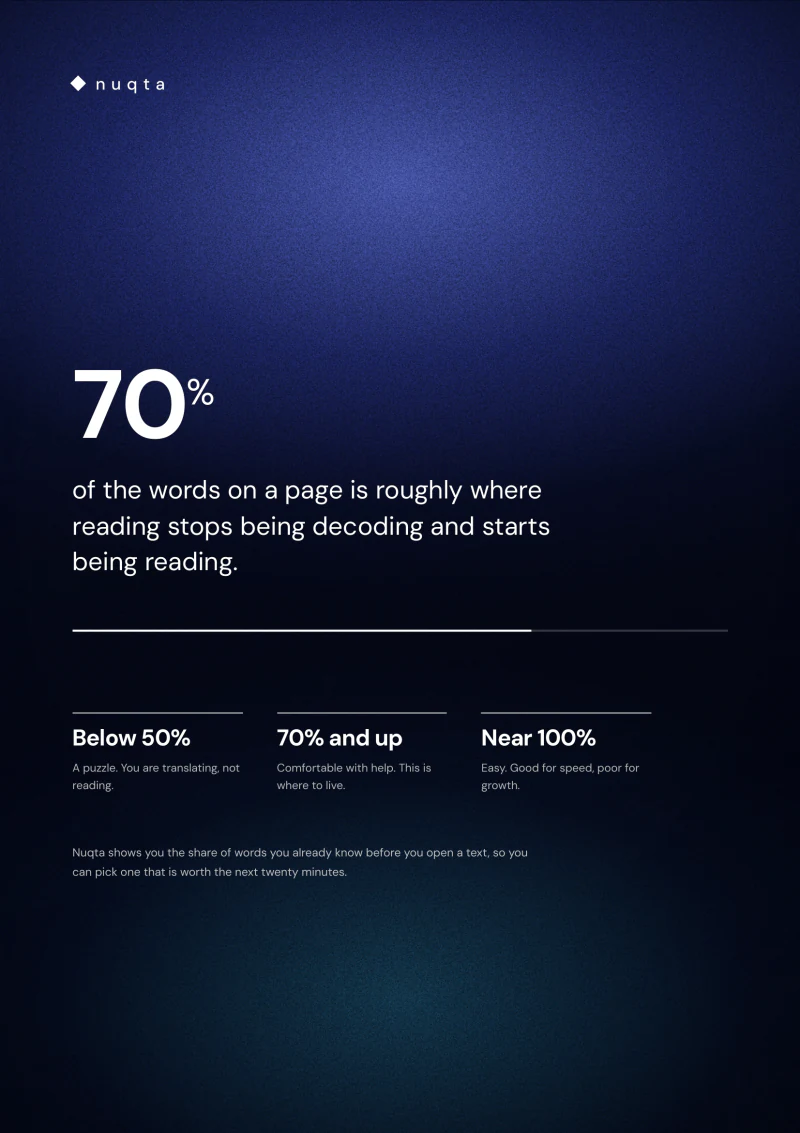
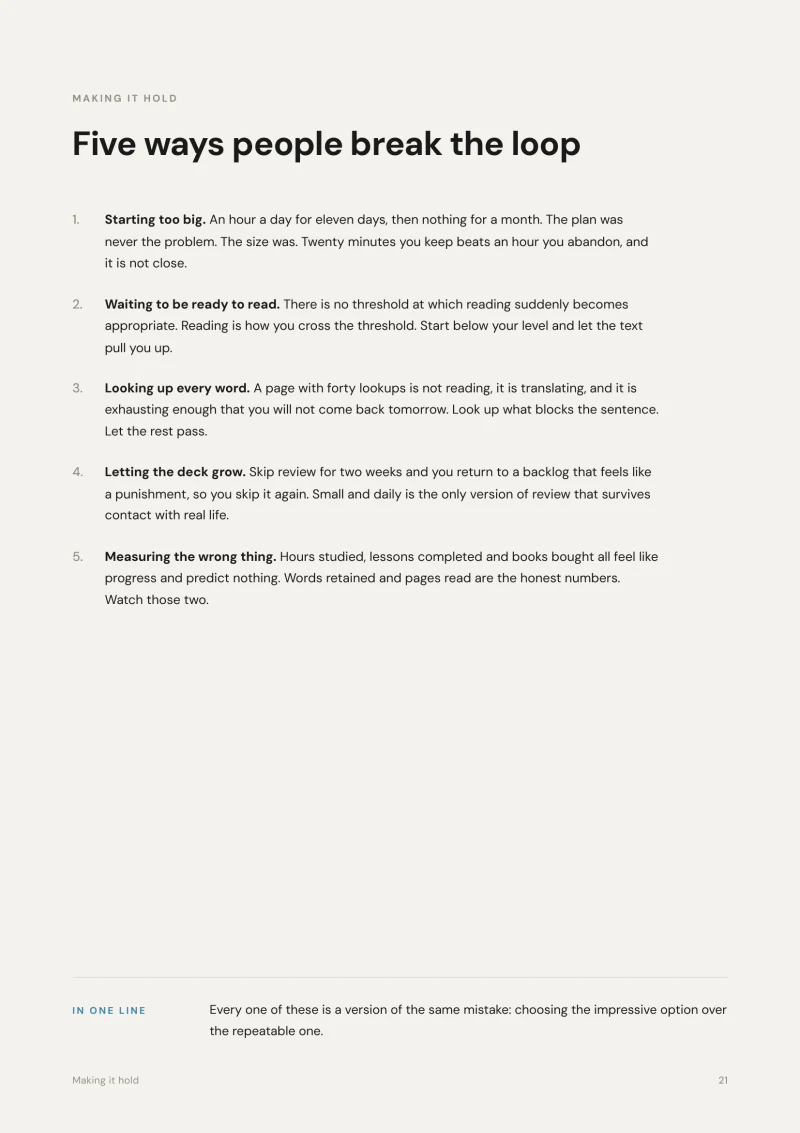
The same guide as a 25-page PDF, with a worked three-stage study plan and practical tips on keeping twenty minutes a day.
Download the PDF